2026-10-07 · Mark Hayes
Foundation Jacks vs House Support Jacks: Which Does Your Home Need?
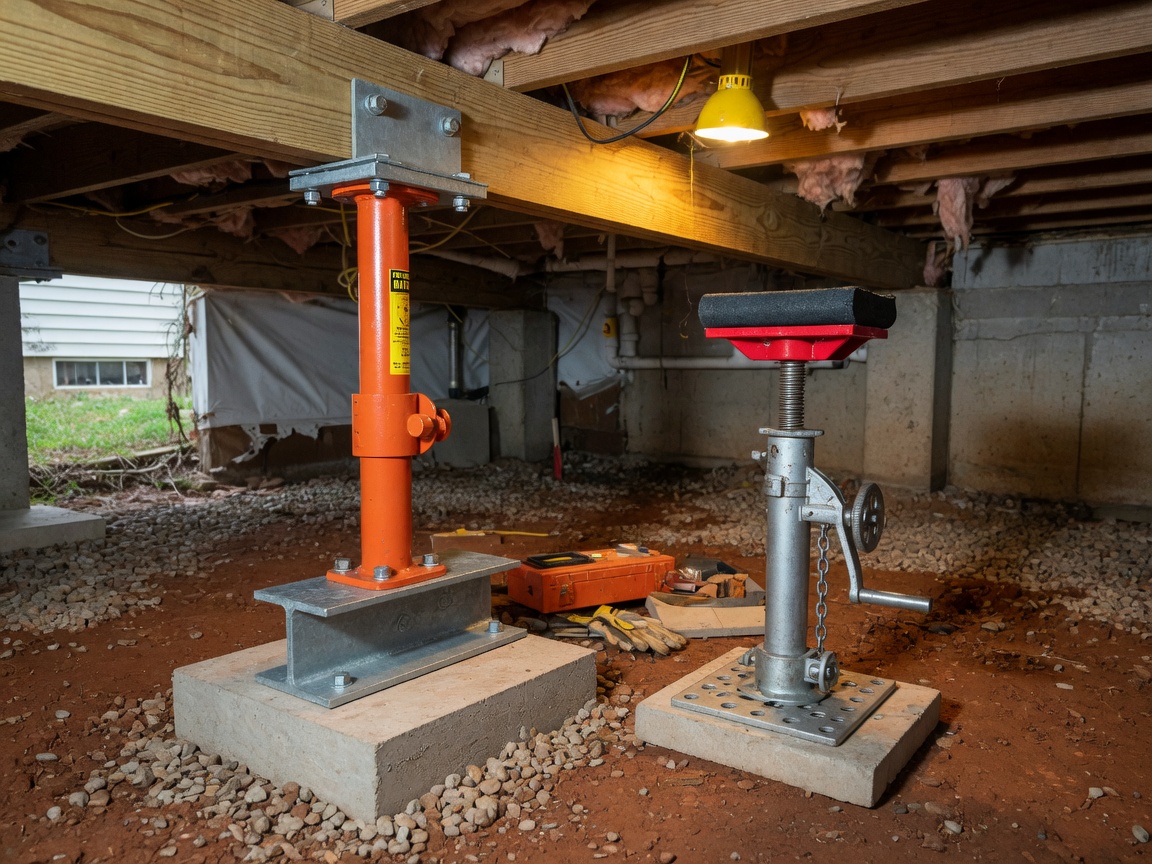
Most Oklahoma City homes with pier and beam foundations need foundation jacks for localized support rather than house support jacks, which apply when entire structures require lifting due to severe, uniform settling from red clay expansion after frequent thunderstorms.
Distinguishing Foundation Jacks from House Support Jacks
Foundation jacks install under individual beams or piers in crawl spaces to correct isolated settling without disturbing the full structure. They use adjustable steel columns rated for 20- to 40-ton loads and allow precise leveling of sagging sections common in older Bricktown and Midtown homes built on Oklahoma County clay. House support jacks, by contrast, employ larger hydraulic or screw systems placed at multiple perimeter points to raise an entire home several inches at once. This approach fits slab-on-grade properties or cases where water damage from warm humid summers has caused broad foundation movement across Del City or Midwest City. The choice hinges on inspecting beam condition and measuring differential settlement rather than applying one method universally.
Oklahoma Soil, Storms, and Their Impact on Jack Selection
Red clay soils throughout Oklahoma County expand when saturated by severe thunderstorms and contract during cold winters, creating the heaving and shrinking that shifts pier and beam supports unevenly. Homes in The Village and Warr Acres often show beam rot or pier sinkage after repeated cycles, making targeted foundation jacks the practical fix because they stabilize specific low points without over-lifting stable sections. In contrast, properties near the Oklahoma State Capitol or Automobile Alley that sit on filled lots may experience uniform downward movement after prolonged wet periods, calling for house support jacks to restore level across the whole footprint. Local terrain drainage patterns around the Bricktown Canal and Myriad Botanical Gardens further influence water accumulation under crawl spaces, directing whether isolated or comprehensive jacking prevents future floor slope.
Signs Pointing to Foundation Jacks in Your Crawl Space
Inspectors look for sagging floor joists over 1 inch in a 10-foot span, doors that stick only in certain rooms, and visible pier lean inside the crawl space. These indicators appear frequently in Moore and Bethany neighborhoods where original 1950s construction used shallow footings on expansive clay. Foundation jacks restore level at those points while allowing access for related work such as vapor barrier installation. House support jacks become necessary only when multiple exterior cracks exceed 1/4 inch wide, windows bind uniformly, and interior floors slope consistently toward one side after major storm events. Checking soil moisture at 12- to 18-inch depths during site visits confirms whether localized or full-structure intervention matches the observed movement.
Practical Steps to Determine the Right Jack System
Start with a full crawl space examination that measures beam elevations at 4-foot intervals and documents pier condition. Compare readings against original floor plans when available, noting any prior encapsulation or dehumidifier work that may have slowed moisture cycles. If differential settlement stays under 2 inches and remains confined to interior beams, foundation jacks paired with new shims provide lasting correction. When total movement exceeds that threshold and affects load-bearing walls, house support jacks allow controlled lifting followed by permanent pier upgrades. Homeowners in Edmond or Norman facing similar conditions often review soil behavior articles before scheduling on-site evaluation to understand why one method fits their specific foundation layout.
Long-Term Considerations After Jack Installation
Once foundation jacks are placed, annual checks during dry winter months verify that adjustments remain stable against ongoing clay movement. Properties near Will Rogers World Airport or Remington Park benefit from pairing the work with improved drainage to reduce water reaching the crawl space after thunderstorms. House support jack projects require more extensive follow-up grading around the perimeter because the larger lift can alter how runoff flows toward Stockyards City or Capitol Hill lots. Both approaches succeed when matched to measured movement rather than assumed as a blanket solution for Oklahoma County homes.